A 1000W portable power station sits in the middle ground of backup power solutions, offering enough capacity to handle essential devices without becoming too heavy or expensive to justify. These units have become popular among campers, remote workers, and homeowners looking for emergency preparedness options. Understanding what they can and cannot power helps buyers make informed decisions and avoid disappointment.
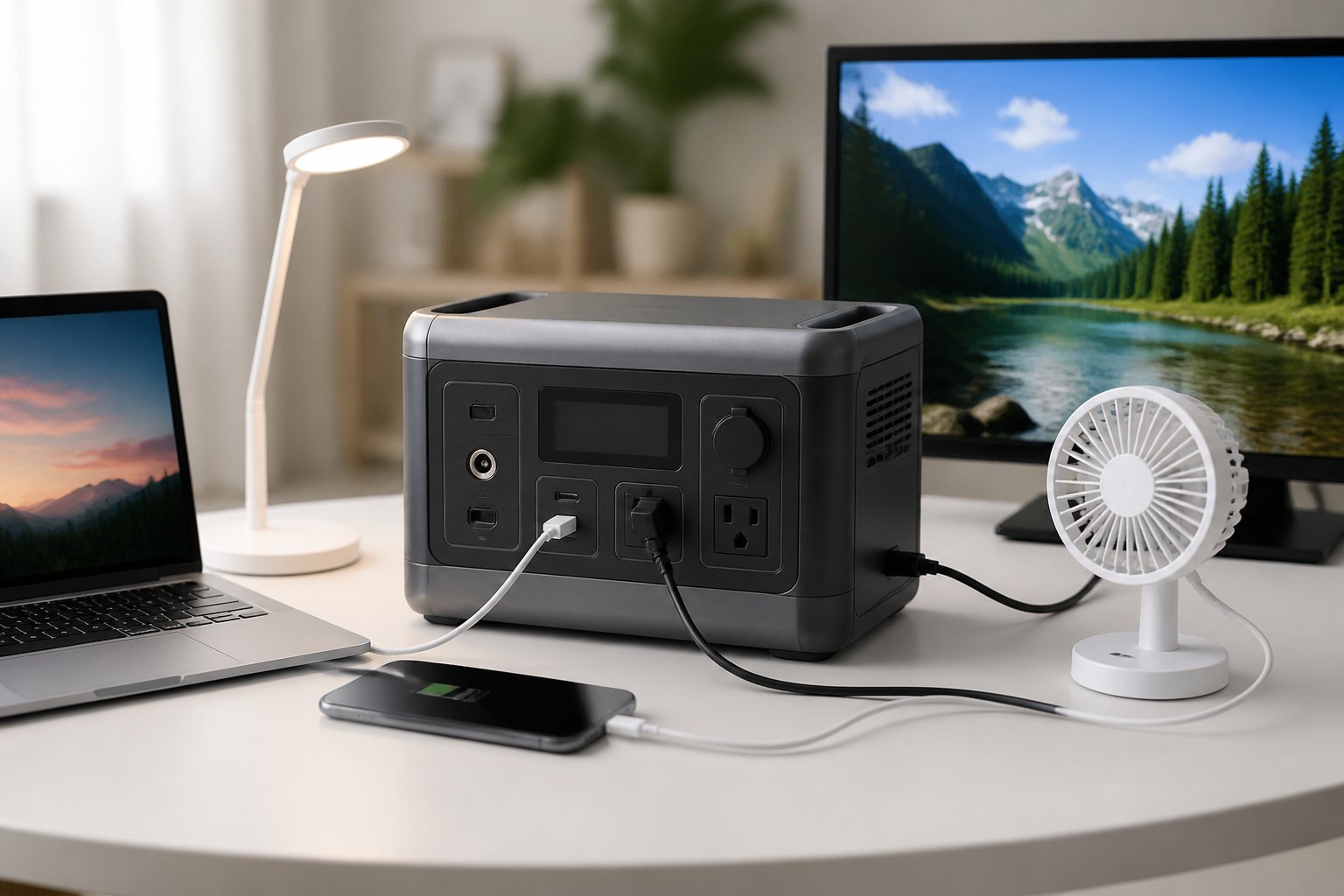
A 1000W power station can run smartphones, laptops, mini fridges, LED lights, TVs, fans, CPAP machines, and small kitchen appliances like blenders and coffee makers, but it cannot handle high-draw devices like space heaters, hair dryers, or window air conditioners. The actual runtime depends on both the wattage rating and the battery capacity measured in watt-hours, which are two different specifications that work together to determine performance.
This guide breaks down the technical basics behind power ratings, provides real-world examples of compatible devices, examines how different loads affect battery life, and compares popular models currently available. Whether preparing for an outdoor adventure or building a home emergency kit, knowing the capabilities and limitations of a 1000W portable power station ensures it matches specific power needs.
Understanding Power Ratings and Technical Basics
A 1000W power station’s actual performance depends on three critical factors: the difference between continuous and surge output, how efficiently the inverter converts stored energy, and the total energy capacity measured in watt-hours.
Continuous Output Versus Surge Capacity
The 1000W rating typically refers to continuous running watts—the sustained power output a station can deliver over extended periods. This differs from surge capacity, which handles brief power spikes when devices start up.
Most 1000W stations offer surge watts ranging from 1500W to 2000W for a few seconds. This startup surge accommodates motors, compressors, and pumps that require 2-3 times their running watts during initial operation. A refrigerator running at 150W might demand 450W at startup, making surge capacity essential for real-world functionality.
Appliances without motors—like laptops, phones, and LED lights—draw consistent power and don’t require surge capacity. Motor-driven devices pose the greatest challenge and require checking both the continuous and peak ratings before use.
Inverter Efficiency and Inverter Efficiency Explained
The inverter converts DC battery power to AC household current, but this conversion isn’t perfect. Most quality stations operate at 85-95% inverter efficiency, meaning some energy dissipates as heat during the process.
A 1000Wh battery doesn’t deliver a full 1000Wh to connected devices. At 90% efficiency, users get approximately 900Wh of usable power. This loss increases under heavy loads or extreme temperatures, reducing both runtime and available capacity.
LFP battery chemistry (lithium iron phosphate) maintains steadier efficiency across discharge cycles compared to standard lithium-ion alternatives. This chemistry also supports more charge cycles before capacity degradation occurs.
Relationship Between Watts and Watt-Hours
Watts measure power consumption rate, while watt-hours quantify total stored energy. A 1000W rating indicates maximum output capacity, not how long that power lasts.
Runtime calculation follows a simple formula: battery capacity (Wh) ÷ device wattage = hours of operation. A 1000Wh battery running a 100W device provides approximately 10 hours, while a 500W appliance runs for 2 hours.
Real-world runtime falls short of theoretical calculations due to inverter efficiency losses and battery protection systems that prevent full discharge. Most stations reserve 10-20% capacity to protect battery longevity, effectively reducing a 1000Wh battery to 800-900Wh of accessible power.
Devices Easily Supported by 1000W Power Stations
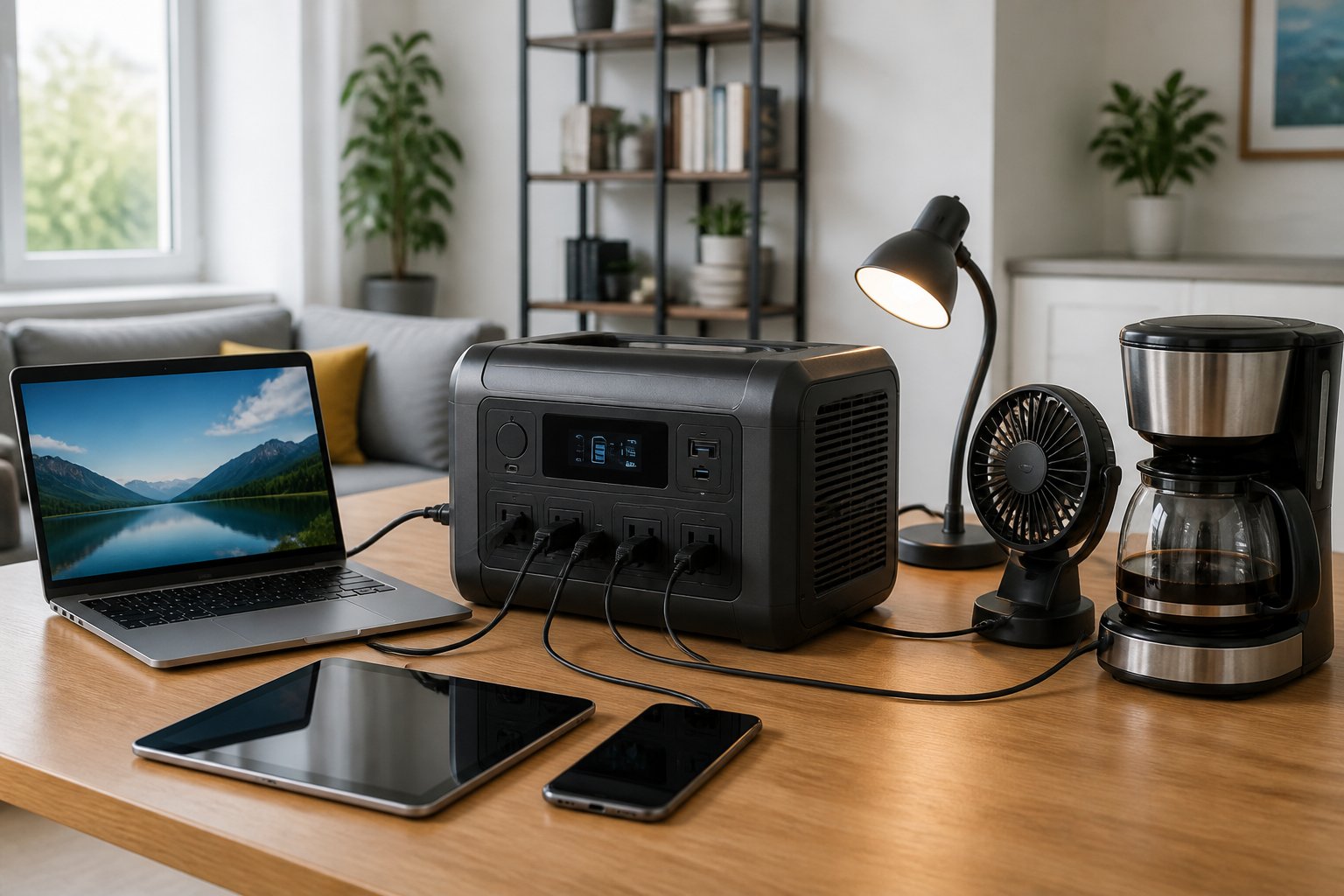
A 1000W power station handles most everyday electronics and essential devices without breaking a sweat. The inverter capacity covers everything from charging smartphones to running medical equipment, while typical battery capacities of 1,000-1,100Wh provide hours of continuous runtime for low to moderate power draws.
Home and Off-Grid Electronics
Electronics represent the easiest category for 1000W stations. Phone charges draw just 5-15W, allowing 60+ full charges from a single battery. Laptop charges consume 30-90W depending on the model, with ultrabooks like MacBooks pulling around 30W and gaming laptops reaching 120W under load.
A WiFi router operates at 10-20W continuously, making it perfect for maintaining internet connectivity during outages or remote work sessions. LED lights are equally efficient at 5-25W per fixture, providing illumination for days on a single charge. A 50-inch LED TV draws 80-120W, delivering eight to twelve hours of viewing time.
Users can run multiple devices simultaneously without approaching the 1000W limit. A complete setup including a laptop, router, LED lights, and phone chargers totals only 100-150W, leaving substantial headroom for additional electronics.
Essential Appliances and Medical Devices
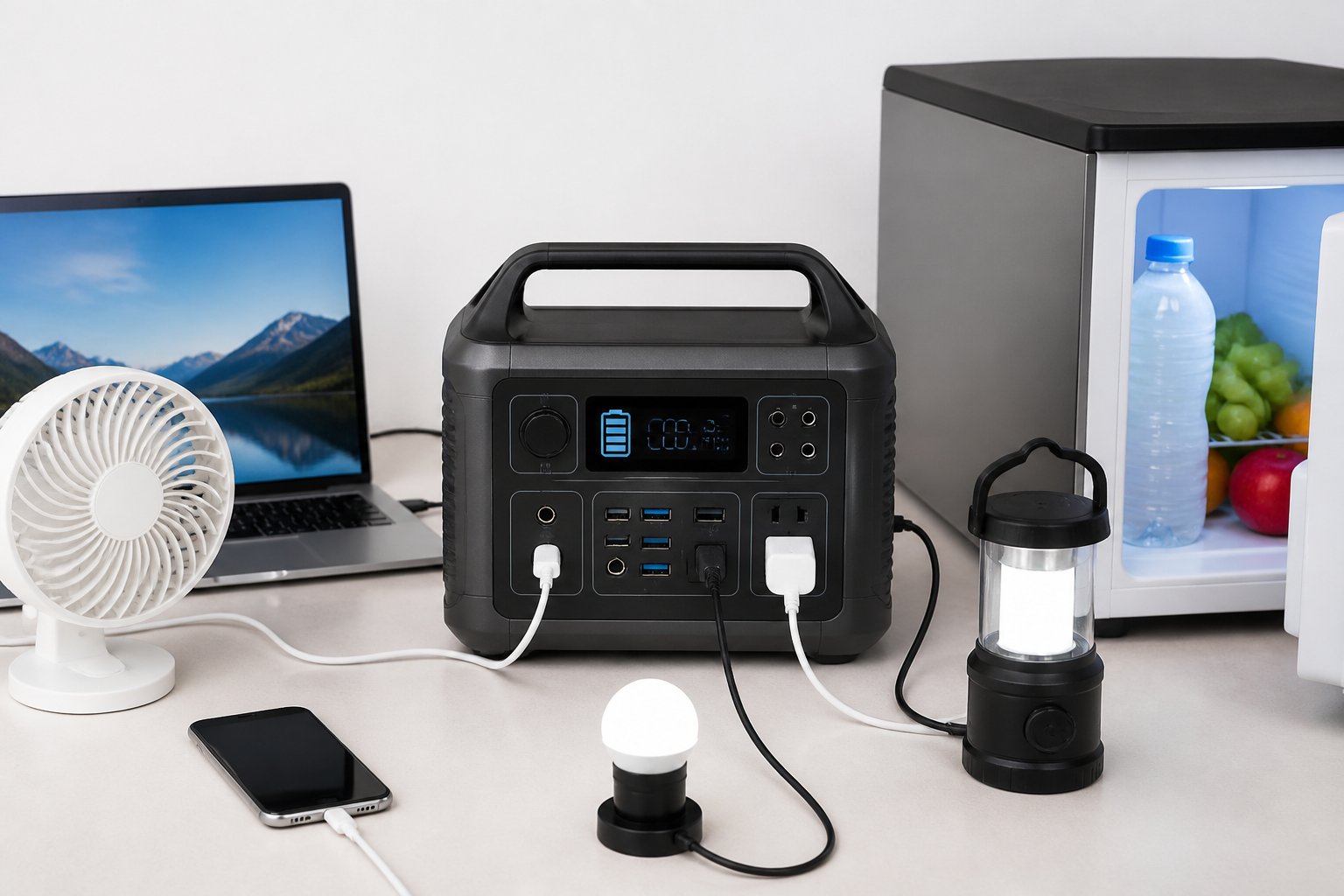
Mini fridges work reliably on 1000W stations, running at 50-80W with startup surges of 200-400W. The station handles these surges easily and can keep a mini fridge operating throughout a power outage. A CPAP machine draws 30-60W without the humidifier and up to 100W with it, providing 14-28 hours of runtime on a 1,000Wh battery.
Electric coolers consume 40-70W for continuous operation. Portable fans operate at 20-50W, making them suitable for overnight use while camping or during power failures. These devices draw minimal power compared to the station’s capacity, ensuring extended use when it matters most.
Medical devices like nebulizers (30-50W) and portable oxygen concentrators (50-150W) stay well within the power limits, making 1000W stations essential backup equipment for users with medical needs.
Charging Gadgets and Small Tools
Tablets charge at 10-20W, allowing 42-85 full charges from a 1,000Wh battery. Camera battery chargers draw 10-20W, while drone chargers need 30-60W per cycle. These low power draws make 1000W stations ideal for photographers and content creators working remotely.
Small power tools like cordless drill chargers (50-100W), LED work lights (25-50W), and portable soldering irons (40-60W) all operate comfortably within limits. Electric shavers pull just 10-15W, and streaming devices like Roku or Fire Stick use only 3-5W.
The stations also support UPS mode on many models, allowing automatic switchover during power failures to keep critical devices like routers, modems, and security cameras running without interruption. This feature protects against data loss and maintains connectivity during grid instability.
Appliances at the Output Limit and Special Considerations
Devices that draw close to 1000W require careful planning because they leave no headroom for inefficiencies or simultaneous use, while motor-driven appliances can exceed the station’s surge capacity even when their running watts fall within limits.
High-Draw Kitchen Devices
A coffee maker typically draws 800-1000W, placing it right at the output ceiling for most 1000W stations. Running one means dedicating the entire inverter capacity to that single appliance, with nothing else plugged in simultaneously.
Blenders usually need 500-700W but can spike higher during thick blends or ice crushing. A 1000W station handles basic smoothies without issue, but users should expect the battery to drain quickly—often consuming 15-20% capacity for a single blending session.
Small toaster ovens and single-serve espresso machines fall into this same category. They function on a 1000W station but offer limited runtime and require users to unplug other devices first. For extended or frequent use of these appliances, a 1500W or 2000W station provides more practical headroom.
Power Tools and Devices With Startup Surge
Startup surge describes the brief power spike when motor-driven tools or appliances first turn on. A circular saw rated at 800W running watts might pull 1600W for the first second, immediately triggering overload protection on a 1000W station.
Check the station’s surge capacity specification—some models tolerate 2000W peaks for a few seconds, while budget units may only handle 1200W. Drills, saws, and angle grinders often need stations rated for at least 1500W continuous output to accommodate their startup demands reliably.
Compressor-based devices like portable air conditioners and full-size refrigerators also surge during compressor startup. Anyone planning to run these should consult a refrigerator guide specific to power stations, as most 1000W units lack sufficient surge margin for anything beyond mini-fridges.
Limitations for Large Appliances
Space heaters, hair dryers, and standard microwaves typically require 1200-1800W, placing them firmly outside a 1000W station’s capability. Attempting to run them either fails immediately or forces the inverter into protection mode.
Window air conditioners present a double challenge: high running watts (often 900-1500W) combined with 2-3x surge during compressor startup. Even units labeled at 800W running watts will trip a 1000W station due to insufficient surge headroom.
Full-size refrigerators average 150-200W when running but can surge to 600W or higher at startup. The sustained cycling also drains a 1000Wh battery in 5-7 hours, making them impractical for this capacity class. Users needing refrigerator backup should target stations with 1500Wh minimum capacity and 2000W+ surge ratings.
How Runtime Varies: Battery Size, Loads, and Efficiency
Runtime depends on three critical factors: the battery capacity measured in watt-hours, the power draw of connected devices, and how efficiently the inverter converts stored energy. A 1000Wh power station delivers different results than a 1000W model with a smaller battery, and understanding these differences prevents disappointment in the field.
Estimating Appliance Runtime
The basic formula for calculating runtime is: (Battery Capacity × 0.85) / Device Wattage = Hours of Runtime. The 0.85 factor accounts for inverter efficiency losses that occur during power conversion.
A 1000Wh power station running a 100W television provides approximately 8.5 hours of use (1000 × 0.85 ÷ 100 = 8.5). The same unit powering a 60W laptop delivers roughly 14 hours, while a 40W CPAP machine runs for about 21 hours without a heated humidifier.
Devices with cycling behavior require different calculations. A mini fridge rated at 60W doesn’t draw power continuously—it cycles on and off to maintain temperature. In moderate conditions, actual runtime can extend to 18-24 hours because the compressor only runs 30-40% of the time.
High-wattage appliances drain batteries quickly. A 1000W coffee maker uses the full inverter capacity and depletes a 1000Wh power station in roughly 50 minutes of continuous operation.
Impact of Inverter Losses and Battery Type
Inverter efficiency typically ranges from 80-90%, with most quality units achieving 85%. This means a 1000Wh power station delivers only 850Wh of usable capacity to devices. Lower-quality inverters waste more energy as heat during the DC-to-AC conversion process.
LFP battery (Lithium Iron Phosphate) technology maintains consistent voltage throughout the discharge cycle and handles more charge cycles than standard lithium-ion. An LFP-equipped 1000Wh power station retains its rated capacity through 3000+ cycles, while conventional lithium batteries degrade faster after 500-800 cycles.
Temperature affects performance significantly. Batteries lose 10-20% capacity in freezing conditions and experience faster degradation above 95°F during operation.
Tips to Maximize Usage Time
Running devices on their lowest effective settings extends runtime substantially. A laptop in power-saving mode draws 30-40W instead of 60W, nearly doubling available hours. Disabling heated humidifiers on CPAP machines reduces consumption from 70W to 40W.
Charge the power station to 100% before deployment and avoid completely draining it below 20% to preserve long-term battery health. Pairing the unit with solar panels enables daytime recharging—a 200W solar panel can fully replenish a 1000Wh battery in 6-8 hours of direct sunlight, depending on charging speed and panel efficiency.
Turn off the AC inverter when only using USB or DC outputs, as the inverter draws 10-20W even with no load connected. Use DC outlets directly for 12V devices like car coolers to bypass conversion losses entirely.
Popular 1000W Power Station Models and Features
The Jackery Explorer 1000 V2, Anker Solix C1000 series, and EcoFlow Delta lineup dominate the 1000W class with different strengths in inverter power, battery chemistry, and charging speed. Each model targets slightly different use cases while staying within the portable 1000W range.
Jackery Explorer 1000 V2 Overview
The Jackery Explorer 1000 V2 delivers 1,500W continuous output with a 1,070Wh LFP battery. The lithium iron phosphate chemistry provides 4,000 charge cycles, significantly outlasting older lithium-ion models.
This model weighs 23.8 pounds and includes multiple ports: two AC outlets, two USB-C ports (100W each), two USB-A ports, and a 12V car outlet. The V2 charges from 0 to 100% in about 1.7 hours using wall power, which is faster than most competitors in this class.
Solar input reaches 800W, allowing quick daytime recharging with compatible panels. The unit includes built-in MPPT charge controllers for efficient solar harvesting. The V2’s inverter handles surge loads up to 3,000W briefly, making it capable of starting small compressor fridges and power tools that other 1000W stations struggle with.
Anker Solix C1000 and Gen 2
The Anker Solix C1000 features a 1,056Wh capacity with 1,800W continuous output and 2,400W surge handling. The original C1000 uses LFP cells rated for 3,000 cycles.
The Gen 2 version (Solix C1000 Gen 2) maintains the same core specs but adds improved thermal management and faster charging. It reaches full capacity in 1.5 hours from a wall outlet. Both versions weigh around 27 pounds.
Port selection includes three AC outlets, two USB-C (100W and 60W), two USB-A, and a 12V car port. The Anker models stand out for their app connectivity, allowing users to monitor battery status and adjust settings remotely via Bluetooth.
Solar charging maxes out at 600W on both versions. The C1000 series includes a five-year warranty, longer than most brands offer at this price point.
EcoFlow Delta Series Comparisons
The EcoFlow Delta 2 provides 1,024Wh with an expandable battery system. Its base inverter outputs 1,800W continuous with X-Boost technology pushing select devices up to 2,400W by regulating voltage. Weight sits at 27 pounds.
The Delta 3 improves with 1,024Wh capacity and 1,800W output while reducing weight to 22.9 pounds. Charging speed hits 1.5 hours from wall power. The Delta 3 adds a waterproof IP54 rating, making it more suitable for outdoor use than the Delta 2.
The Delta 3 Plus scales up to 1,536Wh and maintains the same 1,800W inverter. It weighs 31.3 pounds but handles longer runtimes without external batteries.
All three Delta models charge via AC, solar (up to 500W on Delta 2, 1,000W on Delta 3 models), and 12V car ports simultaneously for faster input. EcoFlow’s app allows remote control and firmware updates across the entire Delta line.
Choosing the Right 1000W Power Station for Your Needs
Not all 1000W stations deliver the same value. The right choice depends on charging speed, specific use cases, and features like UPS mode that protect sensitive equipment during outages.
Key Buying Factors and Use Cases
Battery capacity matters as much as inverter rating. Most 1000W portable power stations pack 1,000–1,100Wh batteries, but some stretch to 1,500Wh. A larger battery at the same wattage means longer runtime for the same devices.
Charging speed varies dramatically between models. Budget units take 7–8 hours to recharge from wall power. Premium models with fast-charging tech hit 80% in under an hour. Solar input capacity also differs—look for stations that accept 400W+ solar for faster off-grid recharging.
UPS mode matters if you’re protecting computers, routers, or medical equipment. This feature switches from wall power to battery backup in under 20 milliseconds when the grid fails, preventing devices from shutting down during the transition. Not all 1000W stations include it.
Use case determines priority. For camping, weight and solar compatibility matter most. For home backup, UPS mode and multiple AC outlets take precedence. For work-from-home setups, pass-through charging—using the station while it recharges—becomes essential.
Comparing 1000W With Other Power Station Sizes
A 1000W portable power station sits between smaller 500W units and larger 2,000W models. The 500W class handles phones, laptops, and lights but struggles with kitchen appliances and can’t touch power tools. The 2,000W class runs space heaters, microwaves, and circular saws but weighs 40–60 pounds and costs significantly more.
The 1000W sweet spot handles CPAP machines, mini fridges, coffee makers, TVs, and most everyday backup needs while remaining one-person portable at 20–30 pounds. It covers roughly 80% of common use cases at 60% of the cost of larger units.
Budget matters. Expect to pay $600–$900 for quality 1000W models. Going smaller saves $200–$300 but sacrifices appliance compatibility. Going larger adds $400–$600 and rarely gets used to full capacity for typical users.
Safety, Portability, and Upscale Features
Weight ranges from 22 to 35 pounds across 1000W models. Stations with lithium iron phosphate (LiFePO4) batteries weigh slightly more than standard lithium-ion but last 3,000–4,000 charge cycles versus 800–1,000 cycles. That’s the difference between six years and fifteen years of regular use.
Safety certifications—UL, FCC, CE—confirm the station won’t overheat or spark during normal operation. Battery management systems prevent overcharging, over-discharging, and short circuits. Quality stations include temperature sensors that shut down the unit before damage occurs.
Upscale features separate premium models from budget options:
- App connectivity tracks battery status and controls outlets remotely
- Expandable batteries double capacity by connecting additional modules
- Multiple charging methods including car charging and USB-C PD input
- Wireless charging pads on top eliminate cables for phones
- LED displays show exact wattage draw and remaining runtime
Portability means more than weight. Built-in handles, compact dimensions, and rounded edges make carrying comfortable. Stations taller than 10 inches or wider than 12 inches become awkward to transport despite acceptable weight.